

Erma Bossi
Pola bei Triest
1882 -
Mailand
1952
Erma Bossi was born in Pola, a town near Trieste, in 1882 or 1885. About 1905 Bossi went to Munich, where she probably trained at the "Damenakademie des Künstlerinnenvereins" ["Ladies' Academy Affiliated with the Ladies'Art Association"]. In 1909 Erma Bossi joined the "Neue Künstlervereinigung München" (NKVM), a progressive art forum from which the "Blauer Reiter" would emerge.
During this period of her career, Erma Bossi was close friends with Kandinsky and Gabriele Münter, who had retired to Murnau on Lake Staffel in Upper Bavaria to paint abstract landscapes in the midst of idyllic rural scenery.
By 1910 Erma Bossi was living in Paris, traveling to Europe and returning regularly to Munich and Murnau. Invitations to show work at the annual "Salons des Indépendants" and "Salons d'Automne" as well as the NKVM exhibitions in Munich brought Bossi into contact with the international avant-garde. Erma Bossi spent the First World War in Milan and Paris. In the early 1920s Bossi showed work at the "New Munich Secession" exhibition; in 1926 and 1929 she participated in the "novecento" exhibitions in Milan and subsequently exhibited at the 1930 and 1935 Venice Biennale.
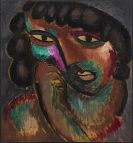
Although Erma Bossi's late work has yet to be studied from the art historical angle, her pictures from the period before the First World War are well-known. She did paintings in the spirit of French Modernism and, as adaptations, these works reveal her preoccupation with Seurat, Matisse, Derain and the aesthetic innovations introduced by Kandinsky and Münter.
By simplifying her subjects and using an intense, expressive palette, Erma Bossi developed an abstract formal idiom. Even though Erma Bossi cannot be regarded as avant-garde, she is an important representative of Modernism.
Her biographical data have not been verified in many instances but she died in Milan either in 1952 or 1960.
![Otto Mueller - Zwei Zigeunermädchen im Wohnraum [historischer Titel]](https://www.kettererkunst.de/still/kunst/picm/22/125000258.jpg)

Would you like to sell a work by Erma Bossi?
Infos for seller


Starting bid: 4,500 EUR